

Skipton: “Happiest Place to Live”? Or the grimmest?
Skipton has recently been heralded as the “Happiest place to live in the UK”, according to a survey. The town in turn has received high praise for its beautiful countryside, friendly locals and fabulous local businesses (as it should have!)
The Skipton Ghost Tour guide, The Butcher, receives weekly praise for her tour around the town’s hidden, most picturesque parts and for relaying its incredible history, which, dear reader, brings us to our point: were the people of Skipton always this happy?
Short answer: absolutely not!
Skipton was by no means always quite so quaint. This now buzzing North Yorkshire market town throughout history has been something of a disease ridden cesspit, a municipality of misery, a town of torture, death and misfortune…
Happiest place to live my eye. Here are 6 reasons why Skipton, historically, was one of the sketchiest places to live:

The Butcher down one of Skipton’s creepiest ginnels
The Yards
The ‘yards’ of Skipton are now a wonderful, unique feature of the town; rows of adorable backstreet terraced cottages. However, they are rooted in incredibly dark times. The yards were developed by the castle for the residents of Skipton to have somewhere to live, with the first ones having been developed around the 1720s. The Castle refused to sell the land in the town and instead offered leases of 40-60 yards worth of land to build upon to live (about 54 metres). The poor people of Skipton had no choice but to accept this measly amount of space and get creative with their building style, and so the terraces were born. They built lots of tiny houses and squished them together. Each house was to facilitate a large family with 10+ people in each. There was no ventilation, the windows didn’t open and to top it all off, they were placed right next to the canal which was described as an “open sewer” back in the day. Unsurprisingly in these squalid conditions, life expectancy was low in Skipton, and if you were unlucky enough to live in the yards, you were unlikely to make it past 35! The Butcher can tell you more about the ghosts who are thought to linger here, and can show you the best preserved example of a Skipton yard!
The Torture
Skipton had many methods of torture, the most often used one was probably the ducking stool. This was a cruel, torturous device used to inflict public humiliation. If a man complained about his wife at home, he could have had her booked into the stool as punishment. You would be tied to a chair and repeatedly dunked under water to replicate the feeling of drowning. Apparently, the Skipton ducking stool (then referred to as a “cucking stool) was so oft-used that it became worn out very quickly, and a brand new, more sturdy stool was happily paid for by the men of the town. It was located at the river, round the back of what is now the big Tesco!
Don’t worry girls, we got our own back on those scumbags. There was also a torturous device which was created by women, for women (to use on their husbands) this was called a “stang”, it was basically a large see-saw on wheels located at the town hall. A group of women would hunt down someone’s horrible husband, collectively tie him to one end of the see saw and then wheel the stang around town for people to chuck rubbish at him! This was known as “riding the stang” Probably would’ve preferred this to a drowning simulator but at least we got our own back in a way.
The Disease
The bubonic plague, typhoid, tuberculosis, influenza and anthrax were just a few of the nasty major diseases that ravaged through Skipton and North Yorkshire. With the previously mentioned ventilation being poor in the yards, and the cesspit of a canal in the centre of town, the people of Skipton did not have good innings, and disease-related deaths were common.
The Mills
Skipton’s spindle mill is another now very comfortable-looking place to live, but back in the industrial era, work-life was rough. Especially for kids. Children would begin their working lives at as young as 4 years of age and would work long hours in dangerous working conditions and cramped living quarters. Crawling under spinning wheels at the end of a 16 hour shift resulted in children getting caught, often, in between heavy parts of machinery, and the loud factory sounds easily would’ve drowned the screams of an injured child…
The Canals
In the 19th century, Lord Thanet of Skipton Castle was not satisfied with the canal as it was. He wanted the canal to go directly to the limestone quarries on his estate. So, he got permission to build his own piece of canal. This involved many workers who were referred to as “navvies” - labourers in other words - who came not only from Yorkshire, but all over the UK, and many came over from Ireland throughout the great hunger. They’d work long, 18 hour shifts and were at constant risk in their work. They were responsible for the UK’s railway systems as well as the canals. The chutes at Thanet’s canal were very long and tall, which made the falling limestone noisy and dangerous. It damaged many of the boats on the water and killed many of the labourers working on site. Check out the navvies memorial on the Otley Ghost Tour - it’s the only memorial that exists to commemorate the lives of these brave workers up and down the UK.
The Ghosts
Well, there’s plenty of them! Skipton’s grim history is heralded by the ghosts who are thought to linger. Throughout time, there has been suffering in Skipton, and many of the most-cheated-in-life people are thought to still haunt the area to this day. From the plagued, terrified soldiers who are said to haunt The Black Horse, to the children who worked in the mill and can occasionally be spotted in the windows near to the Royal Shepherd pub. There are plenty of hard done by ghosts in the lovely town of Skipton, I wonder whether they’d agree with the notion of it being the happiest place to live…
Join us in a celebration of Skipton as the happiest place to live in the UK by exploring its darker side on our ghost and history walking tour of Skipton with The Butcher!
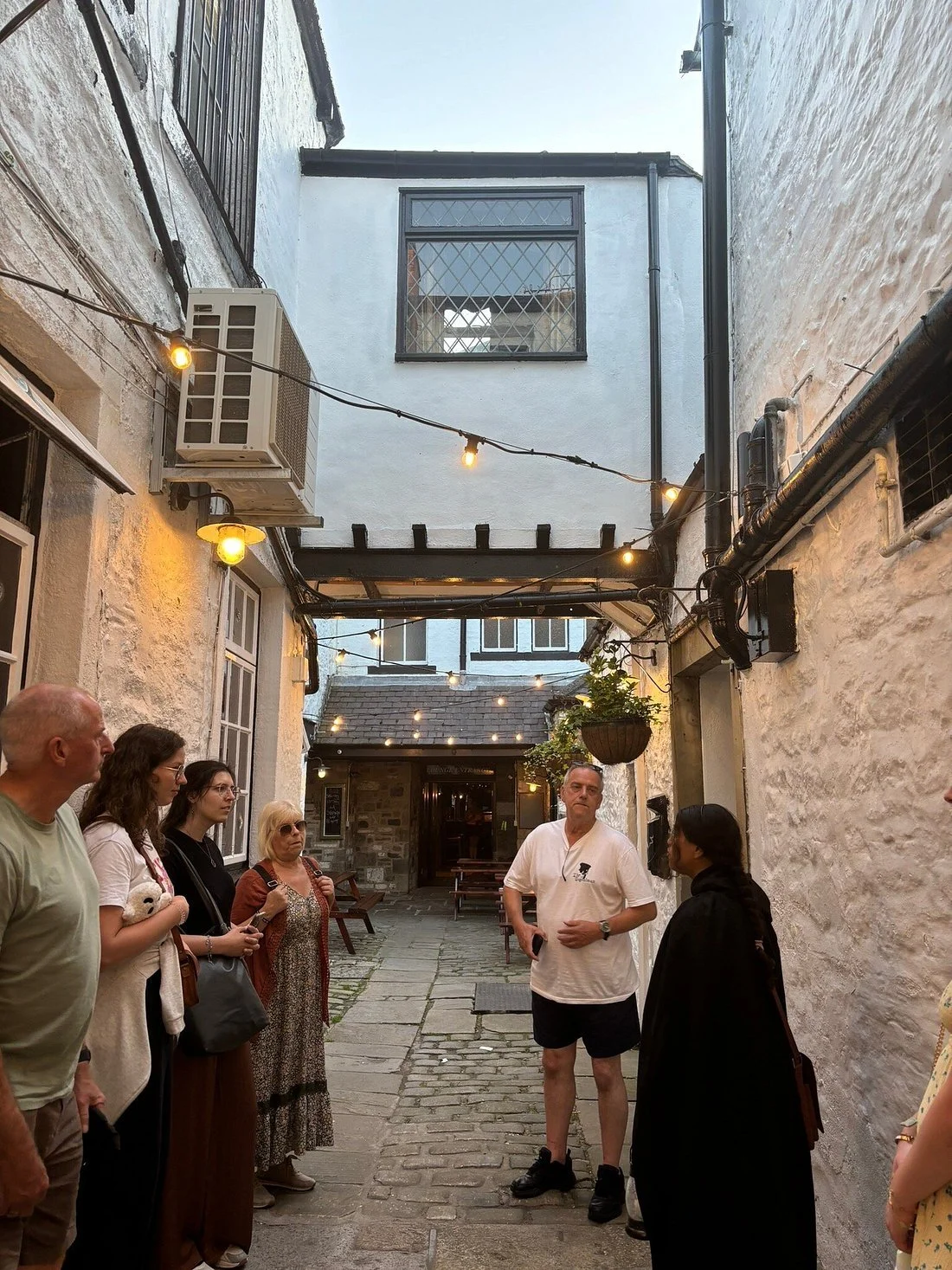
The Butcher telling her tour the story of Ralph Wiggit and the soldiers who haunt The Black Horse
